
Disarm Your Inner Critic: the “Feel Good/Do Better” Confidence Programme
10% happier
Update 15 Nov 2025:
Results are in from the third cohort - and they are even better than the previous two. This cohort had an average 10% improvement in positive thinking, as a result of a few hours work over a few months. Cohort 1 got 4%; Cohort 2 got to 8% - and now Cohort 3 is slightly better again.
Plus even more lovely feedback from the latest participants:
“This programme was great! … the frequency really helped drill the concepts into my brain. I'm feeling so much more positive and able to tackle the negative thoughts that come my way. It really has made a difference:
“Noticeably better which is wonderful.”
"ROAD is the word i am keeping in my back pocket. Really works in terms of looking a things differently. Taking a moment to step outside our norm as such and truly think and reconnect with oneself."
Headline results for the Inner Critic programme (detail below)
This 10% improvement consisted of: 10% reduction in negative thoughts and 11% 'feelings' improvement in how people emotionally felt for the third cohort - detail below
Read more about the new results below (or check out the numbers if you really like the details - feedback welcome).
Sign up with your details below to be part of the next cohort. Still delightfully free - so why not feel a little bit better?
Background: What is the Inner Critic?
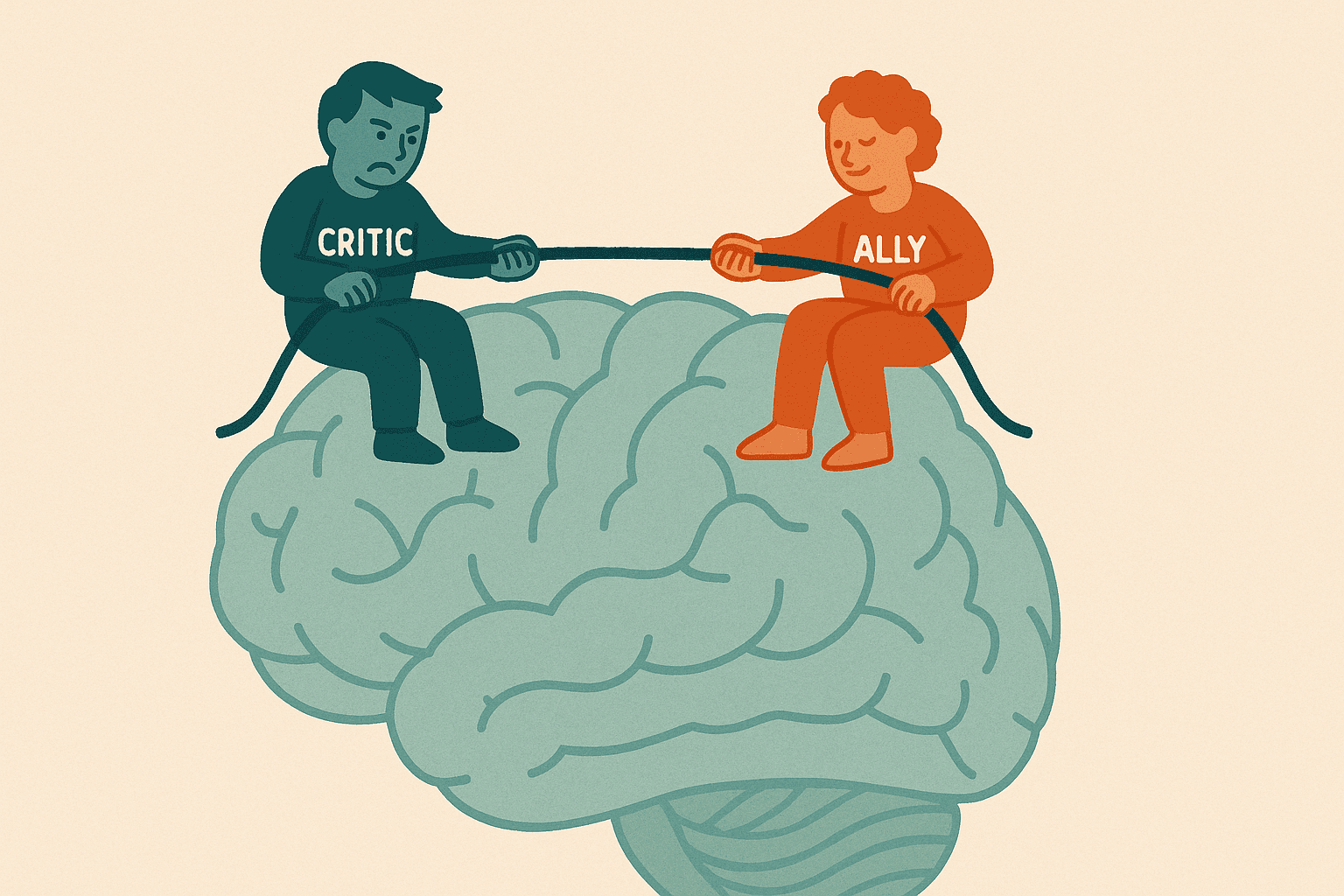
Most of us have the Inner Critic. The nagging voice inside that points out every potential problem, highlights our flaws, and focuses all its attention on the negatives.
It’s the human condition – being aware of threats helps us survive; being aware of positive things doesn’t. So if you had one slightly negative piece of feedback to fifty positive ones – guess where your mind will focus its attention?
Often – it’s useful and somewhat right. Maybe you should do more exercise, spend less time scrolling socials, and have a healthier diet – most of us should. But if it’s constantly nagging you, no matter what you do; if it’s more hurtful than helpful – then quietening it would be good.
Can you imagine having a friendly, supportive voice inside?
Sound nice? Sign up below
What is this Inner Critic Programme?
This programme is devised to help people retrain their brains to disarm the inner critic and feel more positive, confident and happy. It’s a simple process, taking just a few minutes most days to answer questions and try out different tools. After a month or two, you should be better able to be nice to yourself – and feel better inside.
I’ve previously written more detail about the origins and context of the inner critic, and gave an overview of my ROAD framework. This programme builds that framework out into a self-study programme, iterating and deepening each step – Reflect, Observe, Assess, Disarm.
The ROAD Framework
How it works
The exercises typically just take a few minutes. Do them more or less daily over the course of a month or two – participants started to notice a difference even after just a week of frequent practice. Doing it fairly often helps to retrain the brain to more positive thinking – if you do just one exercise every few weeks, or a bunch of exercises together, it’s less likely to have impact. It's a marathon, not a sprint.
The modules each have several questions, a couple of tools and one survey.
Questions – each 'day' of the module has a question to consider, focused on the topic of the current module. Each module has seven "days" - you can aim to do a question a day so a module a week, but slower is normal.
Here's an example of a question from the 'Reflect' module - you respond to the aspects you want; there's just one box to answer:
"What impact does the inner critic have on me? How does it help and how does it hold me back? If it stays as-is and doesn’t reduce - what does the rest of my life look like?"
Tool – a ‘Disarm’ tool to use.
Throughout the programme, you'll use 2 tools: positive journalling and mindfulness - each is used once per module.
The last module 'Disarm' is slightly different - it introduces a new tool daily, and the questions focus on how the new tools worked for you.
Survey – as well as the Benchmark surveys at the start and end of the programme, you'll be asked once per module about how you were feeling for the previous day.
Coach UI web app improvements
The CoachUI web app has improved a lot so the third cohort will have a much smoother experience:
Privacy - there's an option to toggle privacy on, so your answers to the questions aren't visible to me
Better reminders & WhatsApp - you can choose to have check-in reminders in email or via WhatsApp, and set the frequency you'd like ("every X days").
Can see all exercises - all the exercises in a module/step are visible, so you can do a couple of exercises in a day if you want. I suggest you don't do more than two or three, however - doing the exercises slowly over time is better to form new habits
Who is the Programme For?
This program is for you if any of the following feel familiar:
You’re highly capable - but constantly doubt yourself. You might have the title, the role, the experience… yet you still feel like a fraud waiting to be exposed.
You second-guess your every move. A simple email takes 30 minutes to write. You replay conversations, worrying you said the wrong thing. You overprepare, overthink, and still don’t feel “enough.”
You’re exhausted by the voice in your head. That relentless inner critic tells you you’re not smart enough, confident enough, good enough. It’s loud, constant, and often cruel.
You want to lead, create, speak up - but something holds you back. Whether you’re stepping into a leadership role, building a creative career, or simply trying to live with more ease and joy, self-doubt keeps stealing your energy.
You’ve tried being “more positive” or “thinking differently” - but it doesn’t stick. You’re ready for a deeper shift, something more practical and compassionate.
Whether you’re a senior leader or first-time manager; a creative or a parent (or both); a perfectionist, or just tired of your own self-criticism - this program offers tools to quiet the inner critic and amplify your inner ally.
If any of the above resonates – even if you’re not any of these groups – come on, try it out.
Sign up to the next cohort now
The programme is currently still free to participants, while I’m gathering data on its success - I want to quantify further how much positive change participants can expect. You have nothing to lose - so why not sign up today?
Questions? Get in touch.
15 Nov 25 Update - Results from Third Cohort
Great results from the second cohort. They saw an average of 10% improvement in reducing their inner critic.
What does ‘feeling 10% better’ mean?
I measured positive changes in two different ways over the course of the programme - (1) A “thoughts” survey (asked at the start and end), and (2) a “feelings” survey (asked at four stages during the programme), and took the average between the two (10.5%, to be strictly accurate).
Thoughts survey:
Scored frequency of positive/negative thoughts (range –20 to +20).
Average score improved by 4 points, which is a 10% positive shift.
Feelings survey:
Rated daily mood from 0 (dreadful) to 10 (wonderful).
Average mood rose from 6 to 7 - an 11% positive shift.
3 Jul 25 update - Results from Second Cohort
Great results from the second cohort. They saw an average of 8% improvement - even better than the first cohort's 5% improvement
The number of participants is still low - only a few people completed the programme again this round. This was just because the reminder setup meant folks forgot - not because it was difficult. People got just one reminder - so it quickly slipped off the to-do list. So I’m still being cautiously positive, as there aren't many data points.
What does ‘feeling 8% better’ mean?
I measured positive changes in two different ways over the course of the programme - quickish summary here
Benchmark survey- done just at the start and end of the programme, with a couple months gap
It broadly asked: how often did you notice (good or bad) thoughts over the last week?
Answers ranged from 'none of the time' (0) to 'all the time' (5)
'Good' and 'bad' had 4 weighted variants - extremely negative -3; negative -1; positive +1; extremely positive +3
So for example, for the first question
How often did you notice extremely negative (-3) thoughts over the last week?
You might have answered 2 (occasionally)
Giving a score of -6 for this variant
Adding your scores for the four variants together for the start and end surveys, gave an initial total score and a final total score.
Comparing this initial and final total score, I found an average change -4.3 to +0.3 - so a positive change of 4.
This was out of a range of 40 (minimum possible score was -20; max 20)
So it represents a 10% positive shift in thinking.
‘Feelings survey’
This was done four times over the course of the programme, once per module / step of the framework, fairly evenly spaced
This was a simple scale - how did you mostly feel over the last day?
Range went from 0 (dreadful) to 10 (wonderful)
I averaged the first two and last two entries, to see if there was any shift in how people felt between the first and second half of the programme.
The first half average was 5; the second half was 5.5 - so 0.5 positive shift over a range of 10
So there was a 5% positive shift in feelings
Averaging the two sets of results, this indicates an 8% improvement in ‘happiness’ for the second cohort
A statistician would rightly point out that this is bollix
The two surveys were measuring different things - frequency of good/bad thoughts; versus how you felt emotionally.
The surveys were also looking at different time periods - the benchmark asked about the previous week and ran with a gap of months. And the feelings survey asked about the previous day, and ran with a gap of a couple of weeks between.
However, in the human world, it’s two broadly positive results on thoughts and feelings, so I’m comfortable calling it an 8% improvement in happiness. Sorry, statisticians.
3 Mar 25 update - Results from First Cohort
The results from the first cohort are in! And they are… positive! Cautiously positive – it’s from few people and few data points. But – still – decidedly positive.
Just 5 people did the survey more than once a week over the month, with 70 ‘daily survey’ submissions – so not a statistically significant data sample .
But of those 5, when comparing the first half of the month with the second half – there was an average improvement of 1.5 over the course of the month – an impressive 5% improvement. The calculation method was the same as used for the Second cohort's benchmark surveys.
Not bad for a month of occasionally spending a few minutes, some of the days. I wish my muscles improved at the same rate.
Feedback
In addition to this quantifiable change, there was a lot of positive feedback along the way.
“As I progress with it, it’s slowing changing how I perceive or think about things which is really helpful.”
“Too early to judge the results, but I definitely notice that I am able to go back and to think about why I have certain emotions.” (participant after first week)
“Looking for the positive throughout the day changed my mindset”
“I’m finding the daily prompts to focus and remind me to work on this useful”
“I think the program is really good, I got a lot out of week 1. …. I did like the questions, some of them really made me think about things.”
Learning: daily surveys and exercises for a month are – not realistic. (Sorry, guinea pig cohort!) My ‘MVP’ approach was bit too intense. The big change I’m making for the second round is to make it all far more flexible, so it’s easy to pause for a few days along the way, without the gloomy feeling of Things Piling Up. I’m also going to simplify data collection a lot – less frequent, and fewer questions!




Let’s make things better - together.
Powerful questions and real support, tailored to your world.